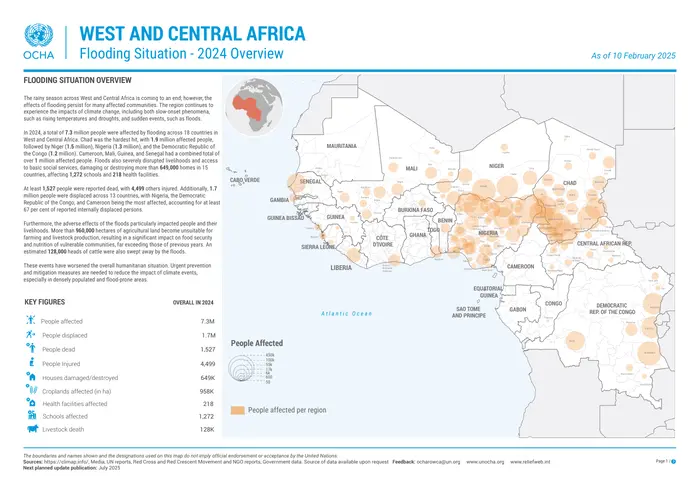
The rainy season across West and Central Africa is coming to an end; however, the effects of flooding persist for many affected communities. The region continues to experience the impacts of climate change, including both slow-onset phenomena, such as rising temperatures and droughts, and sudden events, such as floods.
In 2024, a total of 7.5 million people were affected by flooding across 18 countries in West and Central Africa. Chad was the hardest hit, with 1.9 million affected people, followed by Niger (1.5 million), Nigeria (1.3 million), and the Democratic Republic of the Congo (1.2 million). Cameroon, Mali, Guinea, and the Republic of Congo had a combined total of over 1.1 million affected people. Floods also severely disrupted livelihoods and access to basic social services, damaging or destroying more than 649,000 homes in 15 countries, affecting 1,277 schools and 221 health facilities.
At least 1,527 people were reported dead, with 4,499 others injured. Additionally, 1.7 million people were displaced across 13 countries, with Nigeria, the Democratic Republic of the Congo, and Cameroon being the most affected, accounting for at least 67 per cent of reported internally displaced persons.
Furthermore, the adverse effects of the floods particularly impacted people and their livelihoods. More than 960,000 hectares of agricultural land become unsuitable for farming and livestock production, resulting in a significant impact on food security and nutrition of vulnerable communities, far exceeding those of previous years. An estimated 128,000 heads of cattle were also swept away by the floods.
These events have worsened the overall humanitarian situation. Urgent prevention and mitigation measures are needed to reduce the impact of climate events, especially in densely populated and flood-prone areas.
In 2024, a total of 7.5 million people were affected by flooding across 18 countries in West and Central Africa. Chad was the hardest hit, with 1.9 million affected people, followed by Niger (1.5 million), Nigeria (1.3 million), and the Democratic Republic of the Congo (1.2 million). Cameroon, Mali, Guinea, and the Republic of Congo had a combined total of over 1.1 million affected people. Floods also severely disrupted livelihoods and access to basic social services, damaging or destroying more than 649,000 homes in 15 countries, affecting 1,277 schools and 221 health facilities.
At least 1,527 people were reported dead, with 4,499 others injured. Additionally, 1.7 million people were displaced across 13 countries, with Nigeria, the Democratic Republic of the Congo, and Cameroon being the most affected, accounting for at least 67 per cent of reported internally displaced persons.
Furthermore, the adverse effects of the floods particularly impacted people and their livelihoods. More than 960,000 hectares of agricultural land become unsuitable for farming and livestock production, resulting in a significant impact on food security and nutrition of vulnerable communities, far exceeding those of previous years. An estimated 128,000 heads of cattle were also swept away by the floods.
These events have worsened the overall humanitarian situation. Urgent prevention and mitigation measures are needed to reduce the impact of climate events, especially in densely populated and flood-prone areas.
Published
April 28, 2026
Hazard type
None
Document type
Snapshot
Engagements
162 views / 1 downloads / 1 comments
Notes
The comments section is not available publicly. Some documents are restricted to registered users. Request an account here:
Request an account.