Public documents list
Briefing
Flooding
163 views
1 downloads
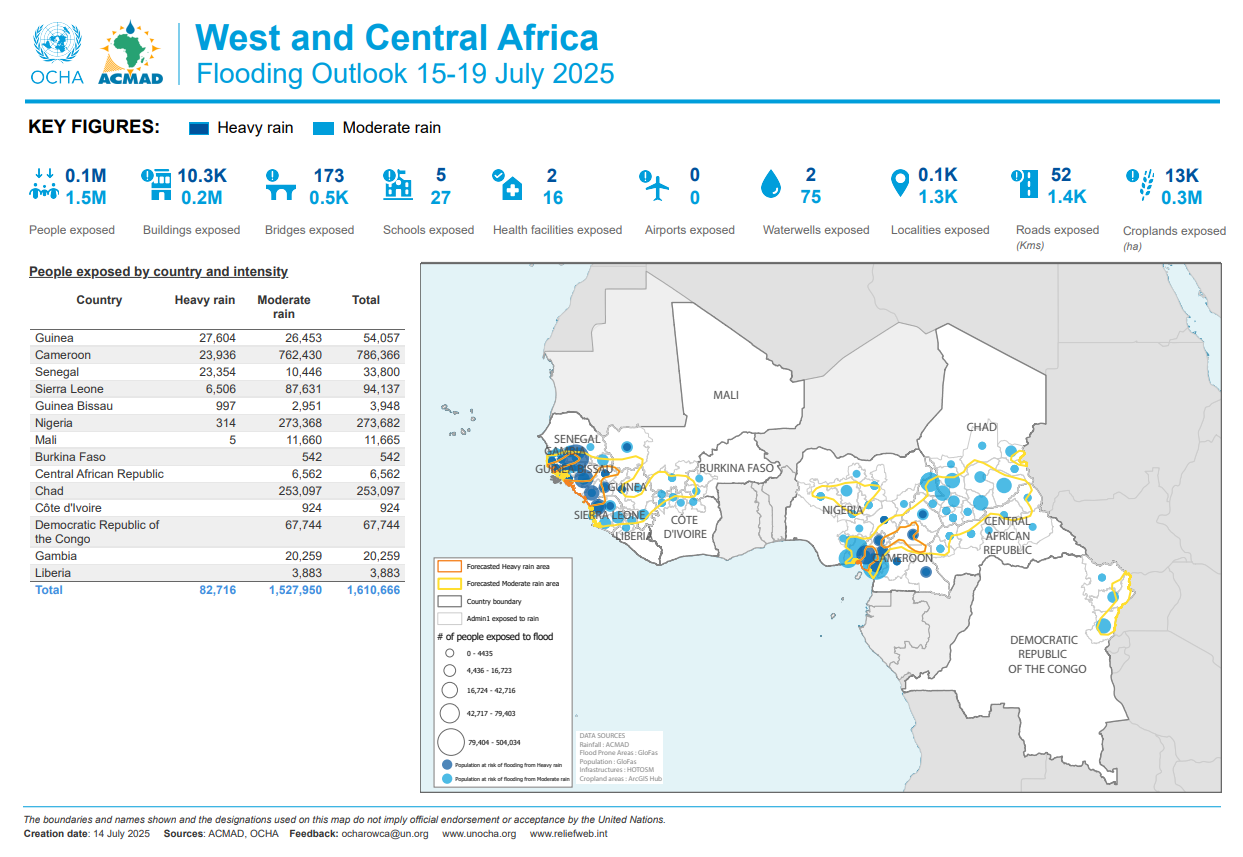
ACMAD -West and Central Africa Flooding Outlook 15-19 July 2025
In the next 5 days, heavy rainfall generated by deep convective clouds is expected in Guinea, Sierra Leone, Nigeria, and Cameroon.
- Heavy rainfall (100-150mm): is very likely in Senegal, nothern, and western Bissau Guinea, western, and northern Guinea, southern Mali,eastern Nigeria, central, and outhwestern Cameroon, northwestern Sierra Leonne, eastern Nigeria, central, and southwestern Cameroon.
- Moderate rainfall (50-100mm): is very likely in southern Senegal, eastern Gambia, central to eastern Bissau Guinea, northern Guinea,
northern and eastern Guinea, southern Mali, across Sierra Leone, northwestern Liberia, northern Côte d’Ivoire, southwestern Burkina Faso, central, and eastern Nigeria, northern, eastern, and western Cameroon, southern Chad, northern Central African Republic, and northeastern Democratic Republic of the Congo.
Snapshot
159 views
1 downloads
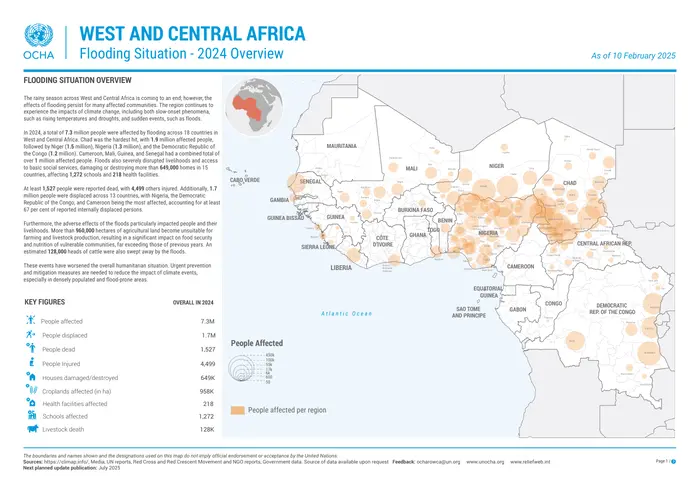
West and Central Africa: Flooding Situation 2024 Overview - as of 10 February 2025
The rainy season across West and Central Africa is coming to an end; however, the effects of flooding persist for many affected communities. The region continues to experience the impacts of climate change, including both slow-onset phenomena, such as rising temperatures and droughts, and sudden events, such as floods.
In 2024, a total of 7.5 million people were affected by flooding across 18 countries in West and Central Africa. Chad was the hardest hit, with 1.9 million affected people, followed by Niger (1.5 million), Nigeria (1.3 million), and the Democratic Republic of the Congo (1.2 million). Cameroon, Mali, Guinea, and the Republic of Congo had a combined total of over 1.1 million affected people. Floods also severely disrupted livelihoods and access to basic social services, damaging or destroying more than 649,000 homes in 15 countries, affecting 1,277 schools and 221 health facilities.
At least 1,527 people were reported dead, with 4,499 others injured. Additionally, 1.7 million people were displaced across 13 countries, with Nigeria, the Democratic Republic of the Congo, and Cameroon being the most affected, accounting for at least 67 per cent of reported internally displaced persons.
Furthermore, the adverse effects of the floods particularly impacted people and their livelihoods. More than 960,000 hectares of agricultural land become unsuitable for farming and livestock production, resulting in a significant impact on food security and nutrition of vulnerable communities, far exceeding those of previous years. An estimated 128,000 heads of cattle were also swept away by the floods.
These events have worsened the overall humanitarian situation. Urgent prevention and mitigation measures are needed to reduce the impact of climate events, especially in densely populated and flood-prone areas.
Briefing
Flooding
164 views
2 downloads
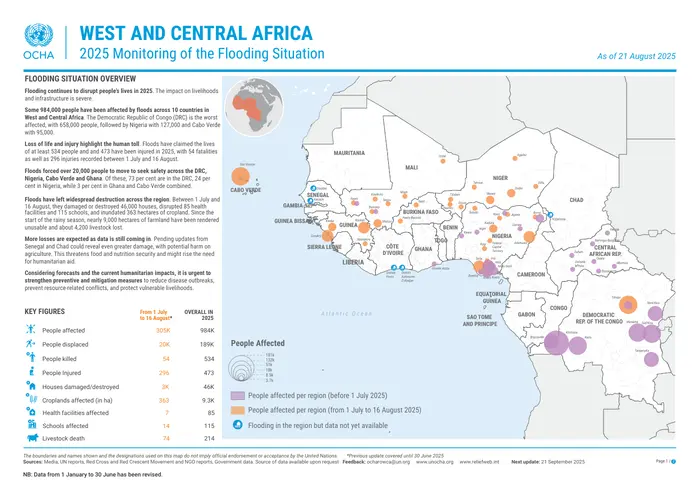
West and Central Africa: 2025 Monitoring of the flooding situation - As of 21 August 2025
Flooding continues to disrupt people’s lives in 2025. The impact on livelihoods and infrastructure is severe.
Some 984,000 people have been affected by floods across 10 countries in West and Central Africa. The Democratic Republic of Congo (DRC) is the worst affected, with 658,000 people, followed by Nigeria with 127,000 and Cabo Verde with 95,000.
Loss of life and injury highlight the human toll. Floods have claimed the lives of at least 534 people and and 473 have been injured in 2025, with 54 fatalities as well as 296 injuries recorded between 1 July and 16 August.
Floods forced over 20,000 people to move to seek safety across the DRC, Nigeria, Cabo Verde and Ghana. Of these, 73 per cent are in the DRC, 24 per cent in Nigeria, while 3 per cent in Ghana and Cabo Verde combined.
Floods have left widespread destruction across the region. Between 1 July and 16 August, they damaged or destroyed 46,000 houses, disrupted 214 health facilities and 115 schools, and inundated 363 hectares of cropland. Since the start of the rainy season, nearly 9,000 hectares of farmland have been rendered unusable and about 4,200 livestock lost.
More losses are expected as data is still coming in. Pending updates from Senegal and Chad could reveal even greater damage, with potential harm on agriculture. This threatens food and nutrition security and might rise the need for humanitarian aid.